
Your Peri-menopausal exercise prescription
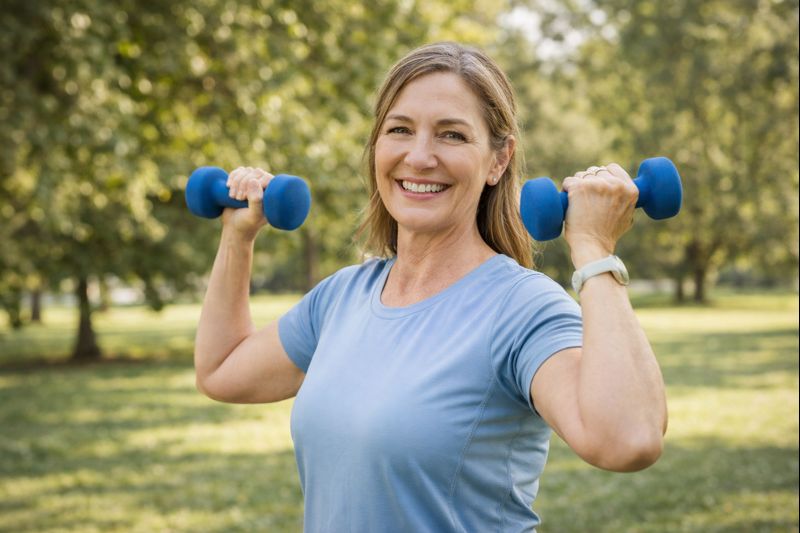
Here’s your peri-menopausal exercise prescription! Please keep in mind that these are general guidelines and of course your body has its unique features and history, which may make these recommendations too easy or conversely, not realistic.
I think that we are in a “Lack of Mobility Crisis.”
Loss of mobility leads to decreased agility, further potentiating a decreased desire to exercise. With declining agility and movement, there is increased risk of falls, and reduced ability to recover from them.
As a naturopathic physician, prevention has always been my core philosophy, and this particular topic is an excellent example of how prevention is so vital.
1 in 3 women over 50 years of age will have a fall that ends in an osteoporotic fracture. Hip fractures carry a 20% one-year mortality rate.
Translation: we need to prevent falls (hello mobility, agility) and decrease fracture risk (by strengthening bones and muscles)
Women are often prescribed medications to increase bone density (which they do, but do they decrease fracture risk? A topic for another time..)
But to focus on bone density is not enough. What we really need is to comprehensively look at the entire range of how we move, which incorporates muscle strength, mobility, agility, power and stability.
By the age of 80, over half of the adult female population are sarcopenia (meaning low muscle mass). And this number will rise with the rising number of women (and men) on GLP-1 agonists, IF they are not dedicated to keeping up with their strength training routines. (The weight loss with GLP-1’s is not just fat).
Here’s an interesting study that I would like to highlight on muscle mass loss.
The ERMA Study Insights Juppi et al. (2020) conducted the largest longitudinal study following 234 women aged 47-55 from perimenopause through early postmenopause.
It was looking at the losses in total lean body mass, lean body mass index, appendicular lean mass (arms and legs), leg lean mass, and the thigh muscle cross-sectional area.
What they found was that menopausal status was found to be THE strongest predictor of muscle mass loss—more predictive than age or activity level alone.
Translation: just going through menopause, no matter how old or active you are, predisposes you to muscle mass loss.
The Bone Density Time Bomb – Bone Loss Acceleration Rates
Normal bone loss is about – 1% per year after age 35. During menopause, this accelerates to -2% to -3% per year for the 5-7 years after menopause, resulting in 10-20% total bone loss in early menopause.
Is this bone loss reversible? Yes, the earlier you intervene the better, but at all points in osteopenia and osteoporosis, you can build stronger bones.
I do believe there is a time and a place for Pharma here. For the most thorough and thoughtful explanation of available prescription medications, I’d recommend Great Bones (see below) and for the same author’s discussion about osteoporosis as being a disease of inflammation, see the Whole Body Guide to Osteoporosis. Both available here: greatbonesconsulting.com/books/
Why is menopause such a concentrated time for bone loss? See my blogs, the musculoskeletal syndrome of menopause, and the androgens blog.
Below, I’d like to highlight 3 studies that focus primarily on how movement is integral for muscle and bone building.
Encouraging news: Resistance Training Effectiveness
Svensen et al. (2025) studied 70 women across pre- menopausal, peri-menopausal, and post-menopausal stages over 12 weeks of resistance training – not on HRT.
Their findings showed no difference in ability to gain strength or muscle mass between menopausal stages.
“There are no non-responders” including 85+ year olds
Clinical translation: You can build muscle at any stage of menopause. Although approaches may need to be tailored to function and body composition outcomes.
And another!
Resistance Training Outperforms HRT Alone, (Isenmann et al BMC Womens Health. 2023)
Resistance training (20 weeks) with compound movements demonstrated greater benefits for bone density than HRT alone, emphasizing the importance of exercise as a foundational therapy.
And another!
Dose-Response: 300 min/week & Impact
(Gonzalo-Encabo et al. Scand J Med Sci Sports , 2019) identified a dose- response relationship where 300 minutes of exercise per week, especially including impact exercises (jumping and heal drops and stomps), resulted in superior BMD improvements which were sustained for 12 months post-intervention.
One more! On exercise with HRT:
Exercise as Medicine: Bone Density Evidence : Combined Approach Yields Best Results (Mohebbi et al.Osteoporosis Int.
2023) found that combining resistance training, impact exercise, and hormone replacement therapy (HRT) produces the most optimal bone mineral density (BMD) outcomes in postmenopausal women.
And now for a general exercise prescription! I am going to break this up into (2) general prescriptions. The first set is for the 80% of women who are not achieving the minimum movement already.
Weeks 1-4: Establish Movement.
Choose one of the options below, and just do ONE at a time.
- Daily walking regimen , 10 minutes per day -or-
- Twice-weekly strength exercises (exercise 3 body parts, 10 minutes total, starting with very light weights – light weights DO increase bone density- -or-
- Daily stretching routine (stretching 2-3 body parts, about 10 minutes total)
Weeks 5-12: Progressive Build
Increase duration, number of repetitions OR weight that you are working with, but don’t do all three, just choose what you are going to increase, and do ONE at a time. You need to feel like you can do more, before you just do more.
- Walking extended to 15-20 minutes -or-
- Additional strength exercises (2- 3 body parts added) -or-
- Include balance challenges to your stretching.
Week 13+: Structured Program
Results only come if you stick with it. Slower starts help to reduce injury and discomfort. By now you should have started to notice improvements with sleep and for sure blood sugar control.
A qualified personal trainer is always a great option for women new to exercise, as they will monitor for exercise intolerance and help recovery period adjustments.
Here are the Advanced Guidelines, for those 20% of post menopausal women who are already in the habit of doing the above workouts.
1. Resistance training, 2-3 sessions per week on non-consecutive days. This means, using compound movements like squats, deadlifts, and rows at moderate to high intensity (>70% 1RM) after adaptation. Using weights that will challenge you to 70-85% of your capacity.
2. Jump/Impact: 5-7 days per week, with 4 sets of 10-20 jumps (takes about 2 minutes). Progress from walking to stomping, jumping, and squat jumps with multi-directional moves. Heel drops and stomps in lieu of impact if necessary.
3. Mobility on most days. Check out the Fishman protocol, a specific 12-pose yoga sequence, which has proven benefits for maintaining bone mineral density (BMD) and significantly improving balance and fall risk reduction. 12 minutes per day, increases bone density by 1% every year, not just the first year!
There are also a number of guided Fishman protocol yoga videos on Youtube.
4. SIT/HIIT 2-4x times per week, go up to your 70-85%. You know you are there when you are breathless in 20 seconds or less. Make sure that you recover between sets (you are recovered when you can breath through your nose.)
How much volume, how many sets?
In general, the recommendation has always been 2-3 sets of 1-2 multi-joint exercises per major muscle group. BUT! Post- menopausal women may benefit from higher volumes, exceeding 8 sets per muscle group, per week for optimal results. See the study below.
Training Volume: How Much is Enough Post-Menopause?
Isenmann et al. (2023) compared pre- and post-menopausal responses to resistance training over 20 weeks. Here are those results.
Pre-menopausal women showed body composition improvements with standard protocols (6-8 sets per muscle group per week). Post-menopausal women required training volumes greater than 6-8 sets per muscle group per week to achieve similar results.
Higher training volumes (80-144 sets per week) in post- menopausal women demonstrated greater metabolic benefits.
Translation: when you can, push yourself for just one more set during your workout, so maybe about 5-10 minutes more work out time.
But remember that you also need the recovery time, and just like postmenopausal women need more sets, they also need more recovery time.
Training Intensity : Use 70-85% of 1RM (one repetition max) or 8-15 reps to near failure to stimulate muscle strength and hypertrophy effectively. 6-30 repetitions performed to muscular fatigue supports muscle strength.
And training needs to continue to be graduated upwards with weights! After 48 weeks of strength training, in order to have continued bone building benefits, it requires you to increase the weight, when viable.
Remember to incorporate Agility, Mobility & Stability into warm ups and cool downs. Allow 48-72 hours recovery between intense sessions and monitor for signs of exercise intolerance,
Consistency Matters More Than Supervision
The research shows that supervision during exercise sessions is less important than maintaining consistent training habits for achieving positive BMD changes. Translation: perhaps you don’t need to go to the gym, but make sure you feel safe exercising at home.
Progression Strategy:
Weeks 1-12: light to moderate loads (15-20 reps)
Weeks 13-48: moderate loads (8-15 reps)
Week 48+ heavy loads rotational basis (6- 8 reps) with recovery for bone mineral density gains.
Increased Recovery Needs
Traditional 48-hour muscle recovery may be insufficient during menopause. Less resilient connective tissue requires more
time.
Sleep and Injury Prevention
One night of sleep deprivation compromises coordination and increases injury risk during balance and agility training, and decreases muscle protein synthesis.
Stability Provides a Safe Foundation: Optimal control of balance regardless of Center Of Gravity and Base Of Support relationship.
The base of support is your feet, but moving the center of gravity up by your navel is important because this helps to prevent falling, like from a slip when one foot goes out from under you.
Translation: your core abdominal muscles are important for fall and fracture prevention.
While hormone replacement status does not limit muscle building, it can certainly optimize it and there has been a clear correlation that it improves exercise adherence. This may be because HRT can reduce menopausal symptoms, potentially improving comfort and motivation, which supports better adherence to regular exercise programs.
And lastly, moving beyond the protein discussion, it may be that insufficient micronutrients are a missing link for developing muscle strength and building muscle mass.
In separate studies, both Liu et al. (2024) and Qiu et al. (2025), identified critical nutrient patterns explaining sarcopenia variance: highlighting the importance of B vitamins (including
Whole Body Vibration Therapy
A 6-month program involving 10×3 or 15×2 sessions of whole body vibration has shown significant increases in hip and femur BMD, offering an effective option for patients with limited mobility who cannot perform traditional resistance exercises.
Check out Osteoboost, which is a new FDA cleared- clinically proven treatment for osteopenia. https://www.osteoboost.com/
To summarize (this has been a hefty post) Movement is EVERYTHING when it comes to keeping your joints mobile and muscles and bones strong. And the winning combination is a mix of strength training, mobility and stretching, and high and low-impact cardio (for example, 2 days a week of HIIT workouts, and a few days per week gentle biking/walking, and at minimum 2-3 times per week for strength training)
When you can, continue to lift heavy things, take the stairs, and continue to challenge yourself. Movement is the key to longevity. Sarcopenia is not an IF, it’s a WHEN. We want to remain as independent and strong for as long as possible.
1. Strength Training: 2-3 times per week, to start. It doesn’t need to be a lot of weight, and it doesn’t need to be for very long. If you are worried about using free weights, start with resistance training with your own body weight.
2. Mobility & Flexibility Work
Pilates and yoga are excellent choices for mobility work, as it helps your joints move through their full range of motion – reducing stiffness and pain. These types of movements also builds strength and flexibility. Often, they incorporate cross body workouts, and breath work, which also benefits your brain and nervous system.
Really focus on your ankles, hips and shoulders, as these joints are going to keep up and mobile for a very long time.
3. Low-Impact Cardio: 150 minutes per week.
Walking (consider adding a weighted vest or ankle/wrist weights for an extra boost), swimming, cycling – anything that gets your blood pumping without excessive strain on your joints.
